
Chưa phân loại
What Is HPPE Fiber? Why It’s Used in Cut-Resistant Gloves
What is HPPE fiber?
HPPE stands for High Performance Polyethylene. It is a synthetic fiber in the same family as UHMWPE (ultra-high-molecular-weight polyethylene), known under trade names such as Dyneema and Spectra.
Chemically, HPPE is still polyethylene, the same base material as plastic bags and plastic jerry cans. The difference lies in its far longer molecular chains and in how the fiber is spun. During spinning, the chains are stretched straight and aligned parallel to the fiber axis. A pulling force is therefore shared across the whole bundle of chains instead of concentrating at single points.
The result is a fiber with four properties that matter for safety gloves:
- High strength-to-weight ratio. The often-quoted figure of “15 times stronger than steel” is a weight-for-weight comparison published by fiber makers. It does not mean an HPPE glove cannot be cut.
- Very light. Its density is about 0.97 g/cm³, lighter than water.
- Slick surface with a low friction coefficient. A sharp edge tends to slide over the fiber instead of biting into it.
- Almost no moisture absorption and good heat conduction. The glove feels cool and stays comfortable over a full shift.
Why does HPPE fiber resist cuts?
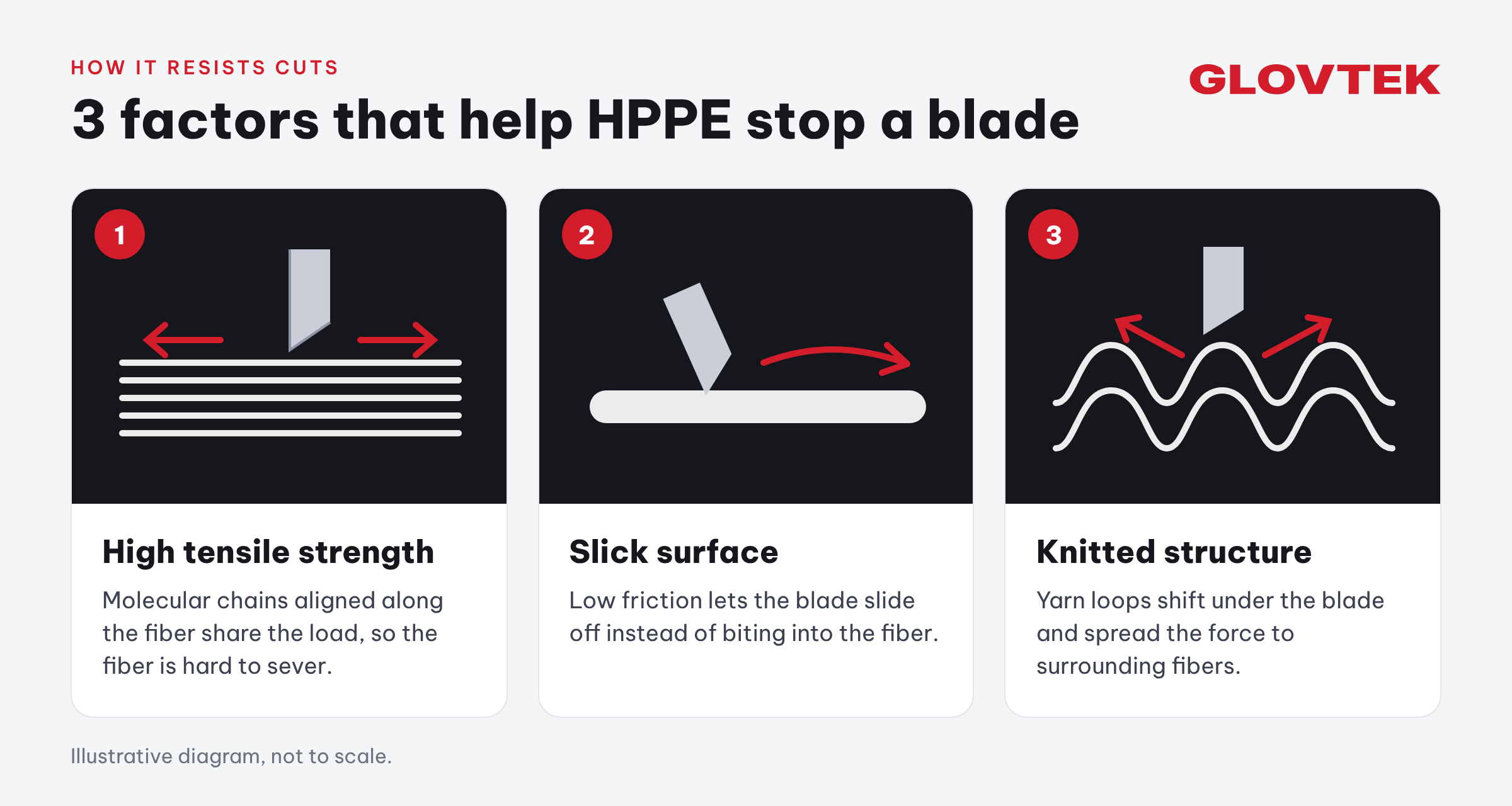
The cut resistance of an HPPE glove comes from three factors working together, not from fiber strength alone.
The first is tensile strength. To sever a fiber, a blade has to break a bundle of aligned molecular chains, which takes far more force than cutting cotton or polyester.
The second is slickness. As a sharp edge passes over it, HPPE lets the blade slide away, reducing the cutting force that actually acts on the fiber.
The third is the knitted structure. The yarn loops can shift and roll slightly under the blade, spreading the force to the surrounding fibers.
The effect of HPPE is easy to see within the Glovtek range. The general-purpose models MP13 and MP15 use cotton, polyester or nylon liners and are rated EN 388 4121X, meaning a cut score of only level 1. The HPPE models AP03 and AN03 are rated 4342B, meaning level 3 in the coup test and level B in the TDM test.
Which EN 388 cut levels do HPPE gloves reach?
HPPE knitted with elastic fibers usually gives low to medium cut levels; reaching higher levels requires reinforcement with glass fiber or steel fiber.
EN 388:2016 grades cut resistance under the TDM test (ISO 13997) into six levels, based on the force needed to cut through the sample:
| TDM level | Minimum cutting force (N) |
|---|---|
| A | 2 |
| B | 5 |
| C | 10 |
| D | 15 |
| E | 22 |
| F | 30 |
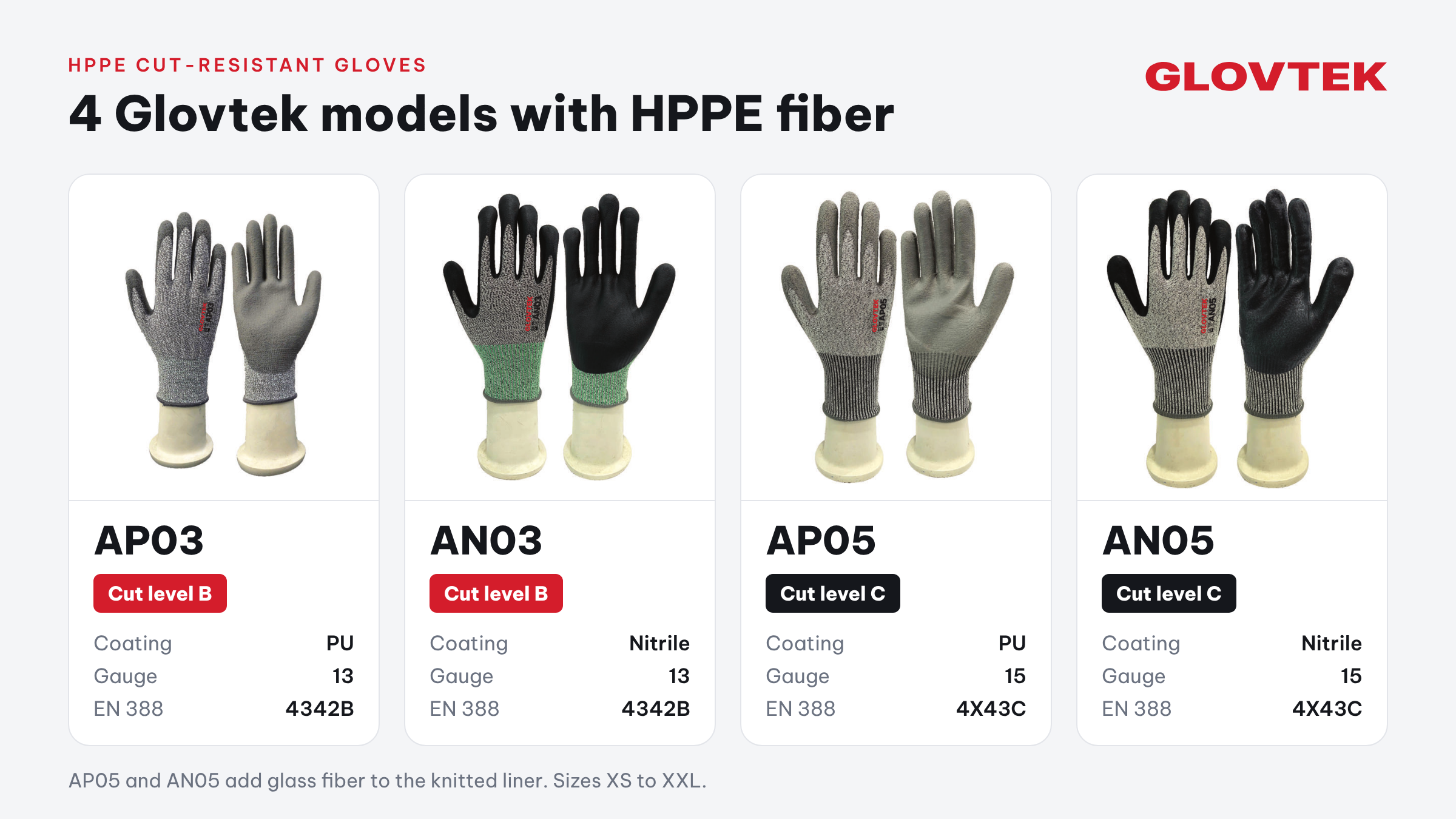
Glovtek’s four cut-resistant models show the role of reinforcing fibers clearly:
| Model | Knitted liner | Coating | Gauge | EN 388 | TDM cut level |
|---|---|---|---|---|---|
| AP03 | HPPE, Spandex, Polyester | PU | 13 | 4342B | B |
| AN03 | HPPE, Spandex, Polyester | Nitrile | 13 | 4342B | B |
| AP05 | HPPE, glass fiber, Nylon, Spandex, Polyester | PU | 15 | 4X43C | C |
| AN05 | HPPE, glass fiber, Nylon, Spandex, Polyester | Nitrile | 15 | 4X43C | C |
The X in the second position for AP05 and AN05 is not a poor score. Glass fiber dulls the circular blade used in the older coup test, so that result is no longer meaningful and the cut level is taken from the TDM test instead.
Why blend HPPE with glass fiber, Spandex and Nylon?
Cut-resistant gloves are almost never knitted from 100% HPPE; each added fiber does a specific job.
- Glass fiber is hard and dulls the blade, raising cut resistance from level B to C or higher. The trade-off is a slightly stiffer glove.
- Spandex adds stretch so the glove fits snugly and does not loosen after a few hours of wear.
- Nylon and Polyester form the base yarn, improving abrasion resistance and keeping the cost reasonable.
HPPE compared with Kevlar and steel fiber
HPPE is strongest on lightness, coolness and cost; its clearest weakness is heat.
| Criterion | HPPE | Aramid (Kevlar) | Stainless steel fiber |
|---|---|---|---|
| Cut resistance | Medium, high when reinforced | Medium to high | High |
| Heat resistance | Poor, melts at about 130–150°C | Good, does not melt | Good |
| Comfort | Cool, light, soft | Warmer, absorbs moisture | Heavy, stiff |
| Abrasion resistance | Good | Medium | Good |
| Resistance to UV and bleach | Good | Weakens in sunlight and with chlorine bleach | Good |
| Lint and fiber dust | Low | Higher | Low |
| Cost | Lower than aramid | High | High |
Quick rule: for cold work that needs dexterity, choose HPPE. For work involving heat, such as welding or handling hot parts, choose aramid or leather gloves. For heavy cutting, such as meat boning or handling thick sheet metal, you need steel fiber or cut level E or F.
Limitations of HPPE gloves
HPPE gloves are cut-resistant, not cut-proof, and buyers should know four limitations before issuing them.
- Not for heat contact. HPPE softens and loses strength before it melts. Do not use HPPE gloves to handle hot parts, for welding or cutting, or near sparks unless that specific glove model is certified to EN 407.
- Limited puncture resistance. AP03 and AN03 score 2 for puncture, AP05 and AN05 score 3, on a scale of 4, measured with a standard stylus. The gloves do not protect against needles or fine wire.
- Not near rotating parts. On drills, lathes and rollers, a tough glove that resists tearing can pull the whole hand into the machine.
- No protection once fibers are cut or worn. Replace gloves immediately if they are cut, frayed or show exposed glass fiber.
Choosing HPPE gloves by task
Choose by answering two questions: how sharp is the material, and is the surface oily?
| Situation | Recommended cut level | Coating | Glovtek model |
|---|---|---|---|
| Assembly, handling parts with edges, dry surfaces | B | PU | AP03 |
| Handling parts with edges, oily or greasy | B | Nitrile | AN03 |
| Sheet metal, glass, ceramics, metal burrs, dry surfaces | C | PU | AP05 |
| Sheet metal and metal blanks coated with cutting oil | C | Nitrile | AN05 |
A PU coating is thin and gives good tactile feel for handling small parts. A nitrile coating is thicker, grips better on oily surfaces and is more abrasion-resistant. If your workshop’s risk assessment calls for level D or higher, these four models are not sufficient.
Frequently asked questions about HPPE fiber
Is HPPE fiber heat-resistant? No. HPPE melts at around 130–150°C and loses strength below that point. For work involving heat, use aramid or leather gloves certified to EN 407.
HPPE or Kevlar: which is more cut-resistant? Both give similar cut levels when knitted at the same weight. A glove’s cut level depends more on its reinforcing fibers and knit density than on the fiber name. The practical difference is that HPPE is cooler and lighter, while Kevlar resists heat.
Is HPPE the same as Dyneema? Dyneema is the trade name of one line of UHMWPE fiber. HPPE is the general name for the group of high-performance polyethylene fibers, and not every HPPE glove uses Dyneema.
Can HPPE gloves be washed? Yes, in warm water with a mild detergent, then air-dried. Do not tumble-dry on heat, as heat damages the fiber. [TO BE VERIFIED: maximum water temperature and number of washes recommended by the Glovtek manufacturer]
How long do HPPE gloves last? There is no single figure; service life depends on how abrasive each task is. The reliable approach is to trial a small batch on site and record the number of shifts before replacement.
Conclusion
HPPE fiber is used in cut-resistant gloves because it is strong, light, slick and cool, so workers can wear it for a full shift and still handle parts precisely. The limits to remember are heat and cut level: HPPE blended with Spandex gives level B, and adding glass fiber gives level C.
Sotaville supplies four Glovtek HPPE models, AP03, AN03, AP05 and AN05, in sizes XS to XXL, and can provide sample gloves for on-site trials before large orders. Contact hotline +84 889 108 080 or email info@sotaville.com for advice and a quotation.